
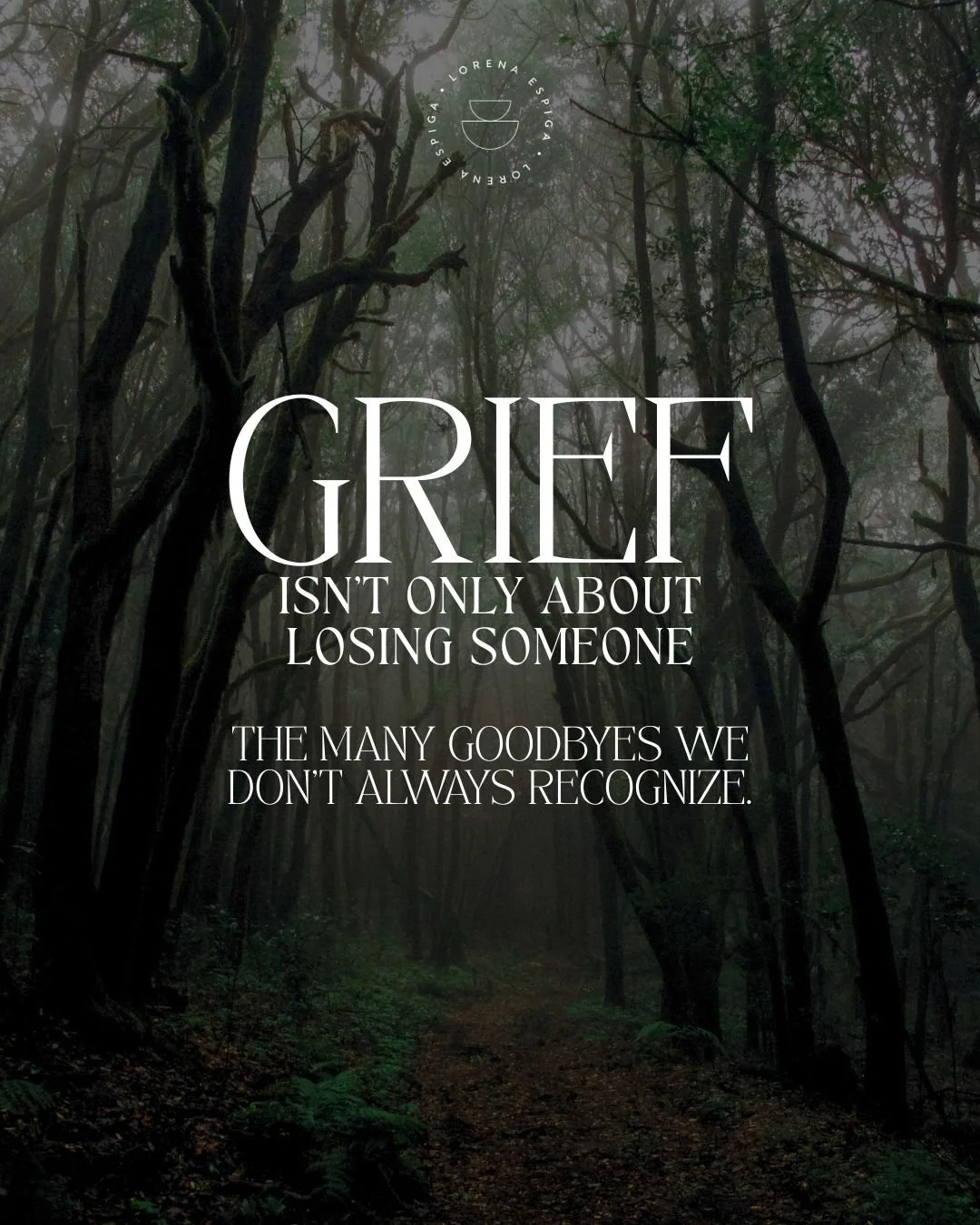
Grief isn't only something we experience after losing someone we love. Sometimes, grief arrives quietly, woven into the transitions that shape our lives. It can appear after moving to a new country, leaving a career, ending a relationship, or even becoming a new version of ourselves. Yet because these experiences don't always come with sympathy cards or rituals, we often don't recognize them for what they are: grief.
Grief Isn't Just About Death
When we hear the word grief, most of us immediately think of losing a loved one. While this is certainly one of the deepest forms of grief, it isn't the only one.
Grief is our natural emotional response to loss, change, and transition. It is the process of adjusting to a reality that no longer looks the way it once did. Every time we say goodbye to something that held meaning, comfort, identity, or hope, we may find ourselves grieving. Sometimes those losses are visible. Other times, they are incredibly subtle.
The Goodbyes We Don't Always Recognize
Throughout our lives, we experience countless endings that rarely receive the same compassion as bereavement.
Perhaps you've moved to another country (or home) and suddenly realized you miss the version of yourself that existed there. Maybe you've left a career that no longer aligned with you, only to discover that you're mourning not the job itself, but the identity it once gave you.
Relationships ending often bring grief not only for the other person, but for the future you imagined together. Even healing can create grief, as we slowly let go of old survival strategies, familiar roles, or parts of ourselves that once kept us safe.
These losses are real, even if no one else can see them.
When Healing Brings Grief
One of the most surprising forms of grief is the grief that accompanies healing.
As we grow, we begin to release identities we've carried for years: the people-pleaser, the perfectionist, the one who always had to stay strong. While we celebrate becoming more authentic, there's often sadness in letting go of who we had to become in order to survive.
Healing isn't simply about gaining a new life. It's also about saying goodbye to an old one. And that goodbye deserves to be honored.
A Family Constellation Perspective
From the perspective of Family Constellations, grief doesn't always begin with us.
Sometimes we unconsciously carry grief that was never fully expressed within our family system. A grandparent who never had the chance to mourn, a parent who buried their emotions to survive, or an unspoken family loss can continue echoing through generations.
When grief is acknowledged, witnessed, and given a place, something within the family system begins to soften.
This doesn't mean we carry responsibility for healing everything that came before us. Rather, it reminds us that emotions often make more sense when we understand the larger story they belong to.
Grief Lives in the Body
Grief is not only an emotional experience…it is also a physical one.
You may notice yourself feeling unusually tired, emotionally sensitive, restless, disconnected, or unable to concentrate. Sometimes people wonder whether something is wrong with them when, in reality, their nervous system is adapting to profound change.
Grief doesn't follow a schedule, nor does it move in a straight line. It comes in waves. Some days we feel steady, while other days a song, a place, or a memory can bring us back to emotions we thought had already passed.
There is nothing wrong with this.
It is simply how the heart learns to make room for a new reality.
Giving Yourself Permission to Grieve
One of the greatest gifts we can offer ourselves is permission.
Permission to cry.
Permission to slow down.
Permission to acknowledge that something meaningful has ended.
Grief isn't a sign that we're weak or failing to move on. It is evidence that something mattered. When we stop trying to rush through it, we begin to discover that grief has its own wisdom. It asks us to honor what was, while gently making space for what is still to come.
Reflection
As you finish reading, I invite you to pause for a moment and ask yourself: What part of my life am I quietly saying goodbye to?
Perhaps it's a relationship.
A place.
A dream.
A version of yourself.
Whatever it may be, know that your grief is worthy of acknowledgment.
Not every goodbye is visible, but every goodbye deserves compassion.
A Gentle Invitation
If this article resonated with you, I encourage you to spend a few quiet moments reflecting on the goodbyes your heart may still be carrying.
You don't need to fix them today.
You don't need to have all the answers.
Simply acknowledging that a loss exists is often the first step toward healing.
Be gentle with yourself.
Grief, like love, asks only to be witnessed.
