
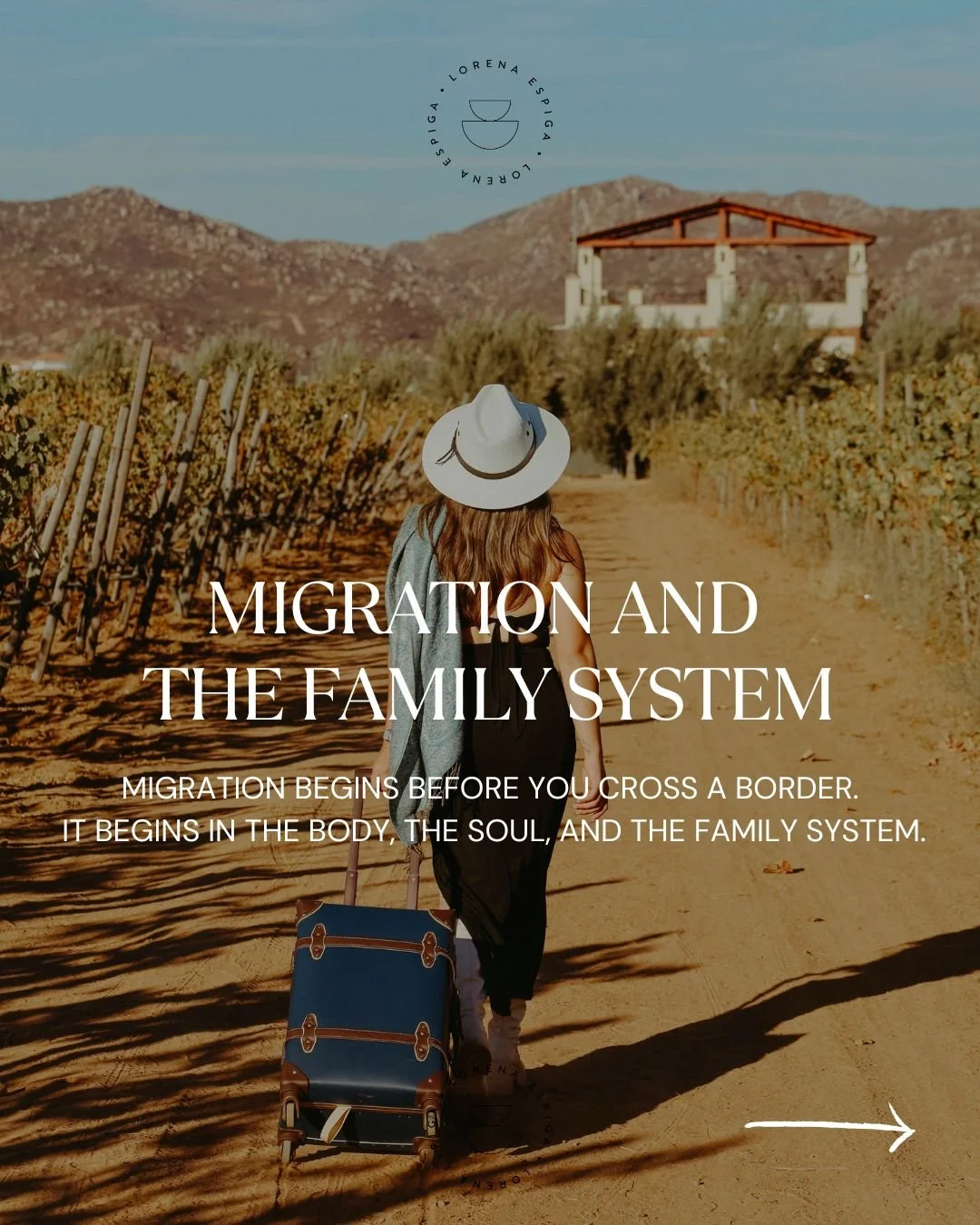
Migration and the Family System
Why leaving home is never only about geography
Migration is rarely just a physical act.
From a systemic perspective, migration is one of the most profound movements a human being can make — not only across land, but across belonging.
Many people believe migration begins when a plane ticket is booked or a border is crossed. But in reality, migration begins long before that.
It begins in the body.
In the nervous system.
In the family field.
It begins when something in the original place no longer holds us in the same way. When our life force starts to orient toward movement, even if we do not yet understand why.
From the lens of Family Constellations, migration is not only personal choice. Often, it is a systemic movement.
Sometimes someone in a family must move so that something unfinished in the lineage can move forward.
Not because they are stronger.
Not because they are more capable.
But because they are positioned in the system in a way that allows them to go.
Migration as a Systemic Task
Bert Hellinger observed that in many families, one member unconsciously carries the movement of expansion for the system. This person may:
move to another country
live differently than their parents
choose a path that diverges from family expectations
On the surface, this looks like individual choice. On a deeper level, it can be a systemic function.
Every family system seeks balance between:
belonging and expansion
loyalty and evolution
When expansion has been limited for generations - through poverty, war, loss, exile, or restriction - someone in a later generation may carry the impulse to move. But this movement often comes with invisible tension.
Because leaving physically can feel like leaving emotionally. And leaving emotionally can feel like betrayal.
The Hidden Guilt of Moving Forward
Many who migrate carry an unconscious guilt that is difficult to name.
It can sound like:
“Why do I get to live differently?”
“Why do I get opportunities they didn’t have?”
“Why does it feel wrong to succeed here?”
This guilt is rarely rational. It is systemic.
It comes from an unconscious loyalty to those who:
stayed
struggled
sacrificed
endured
The system seeks sameness. It seeks continuity.
When one person moves far beyond what the system knows, the system may pull them back through:
homesickness
self-sabotage
financial instability
difficulty settling
relationship struggles
chronic restlessness
Not because they are failing. But because part of them remains oriented backward.
The Split of the Migrating Soul
One of the most common experiences in migration is internal division.
Part of the soul remains with:
the homeland
the parents
the ancestors
the language
the familiar rhythms
Another part tries to root in the new place.
When these parts are not reconciled, the person lives in a kind of internal suspension:
never fully here and never fully there
This can create:
difficulty belonging anywhere
a sense of being between worlds
identity confusion
chronic nostalgia
feeling “unsettled” even when life is stable
From a systemic perspective, this is not pathology. It is unresolved movement.
The system has not yet reorganized to include the new place.
Loyalty to Those Who Could Not Leave
In many lineages, migration is not only about opportunity. It is about unfinished grief.
There may have been ancestors who:
wanted to leave but could not
were forced to leave against their will
lost land, home, or identity
experienced exile
endured displacement
When these experiences are not acknowledged, they remain active in the system.
A descendant who migrates may unconsciously carry:
their grief
their longing
their interrupted movement
Sometimes this shows up as difficulty settling. Sometimes as repeated returns. Sometimes as feeling like success abroad is somehow disloyal.
The system attempts to keep everyone connected. Even across time. Even across geography.
Reordering the Inner System
Healing in migration is not about cutting ties with the past. It is about reordering the relationship.
Family Constellations emphasizes that belonging must remain intact. But movement must also be allowed.
This often begins with an internal acknowledgment:
“I come from here. And I am allowed to go there.”
“I honor those who stayed. And I allow myself to move forward.”
“I take the life that came through them. And I use it fully.”
When this internal reordering happens, something shifts:
guilt softens
roots begin to form in the new place
success feels less threatening
identity becomes more integrated
The new place stops feeling like betrayal. It begins to feel like continuation, an opportunity, expansion and growth.
Migration as Initiation
Migration is often an initiation into adulthood at a systemic level. It asks:
Can you carry where you come from without being bound by it?
Can you move forward without abandoning those behind you?
Can you belong in more than one place?
This is not an easy movement. It is a profound one. It requires grief for what was left. Respect for what came before. Permission to live fully where you are now.
When these elements come into balance, migration stops being fragmentation. It becomes expansion.
A Healing Sentence
In systemic work, simple sentences can support deep internal shifts.
For those navigating migration:
“I honor the place I come from. I carry it with respect. And I allow myself to belong and open my heart to where I am now.”
“I move forward with your blessing. And I live fully.”
Closing Reflection
Migration is not only about geography. It is about identity, belonging, and systemic movement.
If you have moved - across countries, across cultures, across ways of life - you may be carrying more than your own story. You may be carrying a movement for the system. And you are allowed to live it fully. Not as betrayal. But as continuation and honoring those ancestors that came before you.
